 UAE
UAE
How To Calculate PPFD From DLI

Frequently Asked Questions
PPFD (Photosynthetic Photon Flux Density) measures the amount of photosynthetically active light reaching a specific area every second. It is expressed in µmol/m²/s and is one of the most important metrics for evaluating plant grow lights.
DLI (Daily Light Integral) measures the total amount of PAR light plants receive in a full day. It is expressed in mol/m²/day and helps growers understand the cumulative light exposure plants receive over time.
PPFD measures instantaneous light intensity, while DLI measures the total daily light accumulation. DLI is calculated using PPFD and the number of lighting hours provided to plants each day.
The standard formula is: PPFD=DLI×1,000,000Light Hours×3600PPFD = \frac{DLI \times 1{,}000{,}000}{Light\ Hours \times 3600}PPFD=Light Hours×3600DLI×1,000,000 This formula converts the total daily light integral into the average PPFD required over a specific photoperiod.
PPFD directly affects photosynthesis, plant growth rate, crop quality, and yield. Indoor farmers use PPFD measurements to optimize grow light placement and lighting schedules for maximum productivity.
DLI helps growers ensure plants receive enough total light throughout the day. Different crops require different DLI ranges for healthy growth, flowering, and fruit production.
Leafy greens such as lettuce, spinach, basil, and kale generally perform well within: 12–17 mol/m²/day for moderate growth 17–25 mol/m²/day for faster commercial production
Flowering and fruiting crops such as tomatoes, peppers, strawberries, and cucumbers typically require: 20–30+ mol/m²/day for optimal yield and fruit quality
The photoperiod varies depending on crop type and growth stage: Leafy greens: 14–18 hours Herbs: 12–16 hours Fruiting plants: 12–18 hours Longer lighting periods reduce the PPFD needed to achieve the same DLI target.
Yes. DLI can be calculated from PPFD using the formula: DLI=PPFD×Light Hours×36001,000,000DLI = \frac{PPFD \times Light\ Hours \times 3600}{1{,}000{,}000}DLI=1,000,000PPFD×Light Hours×3600 This formula helps growers estimate the total daily light plants receive from grow lights or sunlight.
The ideal PPFD depends on the crop: Leafy greens: 150–300 µmol/m²/s Herbs: 200–400 µmol/m²/s Fruiting crops: 400–800+ µmol/m²/s Commercial vertical farms may use even higher PPFD levels with CO₂ supplementation.
DLI depends on both light intensity and lighting duration. Lower PPFD can still achieve a high DLI if plants receive light for more hours each day.
PAR (Photosynthetically Active Radiation) refers to the light spectrum between 400–700 nm that plants use for photosynthesis. PPFD measures the density of PAR light reaching the plant canopy.
Yes. Outdoor DLI can be estimated using PAR sensors, quantum sensors, or sunlight DLI maps. Greenhouse growers often monitor natural DLI to determine whether supplemental grow lighting is needed.
PPFD is measured using a PAR meter or quantum sensor. These devices accurately measure photosynthetically active radiation reaching plants.
Low PPFD can lead to: Slow plant growth Weak stems Smaller leaves Reduced yield Delayed flowering Plants may also stretch toward light sources under insufficient PPFD.
Yes. Excessively high PPFD may cause: Leaf burn Plant stress Photoinhibition Heat stress Plants must receive balanced light, nutrients, temperature, and CO₂ levels.
DLI provides a more complete understanding of plant lighting because it measures total daily light exposure rather than only momentary light intensity.
Cannabis plants generally require: Vegetative stage: 20–30 mol/m²/day Flowering stage: 30–45 mol/m²/day Higher DLI values often require optimized environmental control and CO₂ enrichment.
LED grow lights allow growers to precisely control: Light spectrum Intensity Photoperiod Energy efficiency This makes LEDs highly effective for managing PPFD and DLI in indoor farming systems.
Related Articles

DLI to PPFD & PPFD to DLI Calculations
PPFD to DLI Calculation DLI to PPFD Calculation
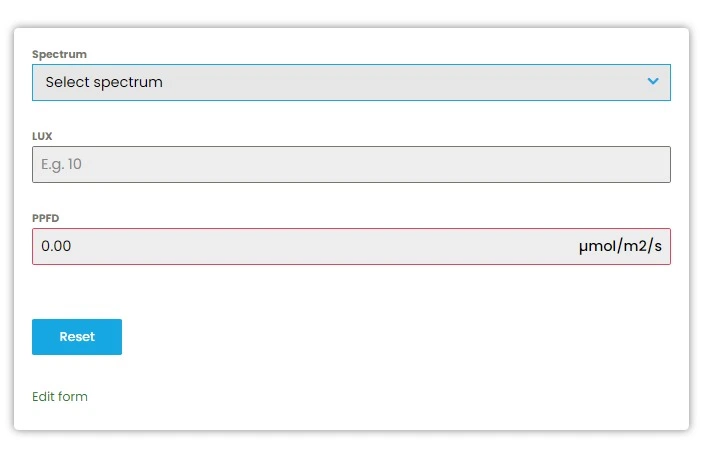
Conversion – Lux to PPFD
The conversion from Lux to PPFD (µmol m-2 s-1) varies under different light sources. For a complete discussion please see the reference listed below.
Don't have an account?
Reset link sent!
Check your email for the password reset link.
Enter your email address and we'll send you a link to reset your password.
Already have an account?

Get Quote
Before You Go!
Get a free consultation from our lighting experts.